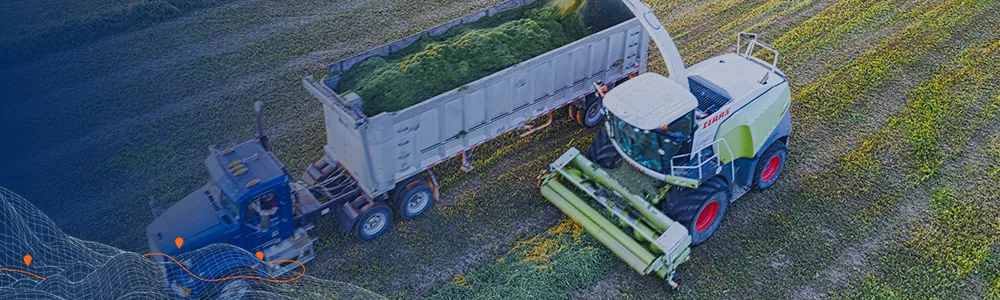

Agriculture is an industry where the efficiency of heavy machinery and resource management directly impact productivity and economic performance. Heavy machinery in this sector operates under high loads, often in remote areas and across vast territories. Tractors, combines, trucks, and other agricultural machinery require regular maintenance, as well as precise control over fuel and consumables.
To optimize costs and improve operational efficiency, Omnicomm offers comprehensive solutions for monitoring heavy machinery and fuel consumption. These solutions help manage fuel expenses, control equipment operation, and enhance overall productivity in farming and agricultural enterprises. The most relevant solutions for agriculture include:
Omnicomm’s monitoring system for agriculture provides complete control over machinery operation and fuel consumption. Installing fuel level sensors enables precise measurement of fuel usage and prevents theft, while GPS-trackers record key operating parameters: location, mileage, speed, and working hours.
For agricultural heavy machinery operating over large areas, the monitoring system allows the use of geofencing, helping track machine activity within fields and improve logistics planning. Fuel consumption control ensures accurate tracking of fuel used for specific operations, optimizing machinery efficiency for maximum savings.
The system also supports integration with ERP systems, which helps automate accounting processes and data exchange related to expenses, machinery performance, and agricultural operations.
The implementation of Omnicomm solutions in agriculture significantly enhances economic efficiency and reduces operating costs. Companies using the monitoring system achieve the following results:
Omnicomm solutions help agricultural companies efficiently manage fuel and technical resources, improving productivity while reducing operational costs.
Yes. The fuel level sensor itself is wired to a GPS tracker or terminal via RS-485 or MODBUS, so it does not depend on a cellular signal to operate. Cellular coverage is only relevant to the connected tracker, which buffers data locally when out of range and uploads it once a network is available again. No fuel data is lost during the gap.
The sensor measures fuel level once per second and outputs that reading on the digital RS-485 / MODBUS interface to whatever terminal is connected: an OMNICOMM tracker or any third-party tracker that supports the LLS protocol. From there, how the offline period is handled is a tracker question, not a sensor question. The terminal stores events in its onboard memory and uploads them on the next available link, whether that link is cellular, Wi-Fi, or a wired connection at the depot. For deployments where vehicles spend long periods out of cellular range (mining haul trucks in pit areas, agricultural tractors across large fields, forestry equipment, offshore vessels), the buyer chooses a tracker with sufficient local storage and the appropriate uplink. See this answer for the full remote-site workflow including how OMNICOMM and partner-supplied trackers handle offline buffering and periodic upload.
Remote sites without reliable cellular or wired internet are a core OMNICOMM use case. The fuel sensor itself is wired to a tracker via RS-485 / MODBUS and works independently of any network. The connected GPS tracker buffers events locally and uploads them on the next available link, whether that is cellular, Wi-Fi at a depot or fuel station, or a wired connection at base. No fuel data is lost during the offline period.
Mining haul trucks operating in pits with no cellular signal, agricultural tractors crossing fields beyond 4G coverage, forestry machinery deep in remote blocks, and offshore support vessels all share the same operating pattern: hours or days without an internet link, followed by occasional time at a base location. Any GPS tracker with enough onboard storage and a Wi-Fi or cellular uplink can handle this workflow; the choice depends on the buyer's existing fleet platform. OMNICOMM's Profi 3.0 Wi-Fi is one option and is built specifically for this pattern, with internal storage that buffers up to several weeks of detailed event data and automatic upload over Wi-Fi when the vehicle parks at a depot or fuel station hotspot. Third-party trackers that support the LLS protocol can deliver the same offline-then-upload behavior using their own buffer and uplink. Fides Mining in Brazil runs OMNICOMM sensors across a 260-vehicle fleet in remote Matupa using this approach. Agricultural and construction fleets in similar conditions follow the same workflow. For permanent installations on stationary generators or fuel tanks at remote sites, the same pattern applies: the chosen terminal handles offline buffering and periodic upload so a generator's daily fuel consumption is captured even when the site has no cellular service for weeks at a time.
Yes. OMNICOMM LLS sensors work with any fuel with a dielectric constant below 5, which covers all common biodiesel blends (B5, B20, B100) and most alternative fuels. FuelScan auto-adaptation recalibrates on the fly when fuel composition changes, so you don't need manual recalibration every time a vehicle refuels at a different station.
Biodiesel blends are mandated at rising percentages across the EU, Brazil, the United States, and parts of Southeast Asia, and each blend has a slightly different dielectric constant than petroleum diesel. Without auto-adaptation, a sensor calibrated for B0 (pure diesel) will misread fuel as soon as the fleet starts buying B7 or B20. Manual recalibration per blend is impractical for trucks that refuel at random stations along a route. OMNICOMM LLS 5, LLS-Ex 5, and LLS 6 AI sensors include FuelScan, which continuously monitors fuel composition and adjusts readings without requiring fleet operators to intervene. The same logic applies to renewable diesel (HVO), winter blends with cold-flow additives, and regional fuel formulations. For fleets in countries pushing aggressive biofuel mandates, this is a structural advantage. Legacy single-probe sensors lose accuracy with each blend change, while FuelScan-equipped sensors hold their 99.5% accuracy across the full fuel landscape.
Read more: Biodiesel is quietly breaking your data and why entry-level sensors overread on B20.
We use cookies for analytics and advertising. They are set only with your consent. Privacy policy