
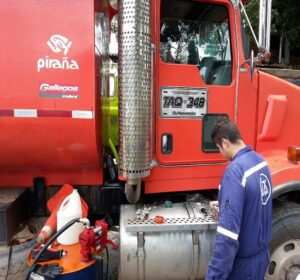

Transport and Fuel Management in Construction

Transport and Fuel Management in Construction

The construction industry operates in challenging environments where equipment reliability, precise fuel consumption monitoring, and efficient fleet management are critical. Heavy machinery and construction vehicles work under high loads, often in remote areas with unstable cellular network coverage. Operators and mechanics face risks such as unauthorized fuel drains, equipment downtime, and inefficient resource utilization.

To address these challenges, a comprehensive approach to fuel monitoring and machine operation is essential. Omnicomm provides a full range of solutions for managing construction equipment and fleets, enabling control over fuel operations, machinery performance, and driver activities, while also integrating with corporate accounting systems. The most relevant solutions for the construction industry include:

Solution Components

Omnicomm’s monitoring system for construction equipment enables control over key transport and machinery parameters. Fuel level sensors provide accurate consumption measurement and prevent theft. GPS-trackers allow tracking of equipment location, operating modes, and mileage.

For operations in remote areas with no stable cellular signal, Omnicomm solutions support extended autonomous operation, ensuring data security and delayed transmission once a connection is available. The company also offers solutions for areas with no cellular coverage at all, allowing automatic data transfer via Wi-Fi. Additionally, the system can be integrated with ERP and monitoring platforms for automated data exchange and tracking of all operations.

Special attention is given to fuel tankers – Omnicomm’s specialized equipment ensures controlled fuel distribution, preventing unauthorized drainage. Furthermore, maintenance tracking systems help plan repairs and prevent unexpected breakdowns.

Achieved Results

The implementation of Omnicomm solutions in the construction industry significantly improves equipment efficiency and reduces costs. Companies using monitoring systems achieve the following results:

Fuel consumption reduction by up to 30%
through controlled refueling, fuel drainage detection, and optimized consumption rates
Reduction of equipment downtime by 20-40%
thanks to performance monitoring and timely maintenance
Fleet optimization
improved equipment location tracking, workload control, and logistics
Integration with corporate systems
automated fuel accounting and fleet management

Omnicomm solutions provide construction companies with full control over fuel consumption and equipment operation, leading to significant cost savings and improved operational efficiency.

Our cases

Frequently asked questions

How much fuel can a fleet save with a fuel monitoring system?

Fleets typically reduce fuel costs by 25-35% within the first months, and up to 50% in some industries. Documented results include 45% fuel economy at Fides Mining (Brazil), 32% savings at SBI International (Tanzania), 24% at ARSS Infrastructure in India (equal to $130,000 in monthly savings), and 12% in the first month at NQC Mexico (a $10,000 monthly saving with payback in under 3 months).

Savings stack on top of each other and the mix depends on how the fleet currently leaks fuel. Theft and fraud prevention is the largest one-time gain in month one after install: Belgrade Municipal's 500-vehicle fleet cut fuel consumption 15 to 40 percent within two months, with theft prevention as the dominant driver in the first weeks. Idle-time reduction comes next, as the platform surfaces vehicles burning fuel while parked and managers retrain the drivers responsible. Route and consumption optimization adds another layer by comparing each driver's L per 100 km against fleet norms and flagging the outliers. Maintenance-driven savings round out the picture, since catching engine inefficiencies early prevents fuel-burn drift. To estimate your own savings, take your current monthly fuel spend, run a conservative 15 percent reduction (idle and consumption alone) and a realistic 30 percent (theft prevention included), and compare against the system cost over 12 months. Most fleets break even well before year-end.

How long does installation take?

A standard single-tank installation takes about 40 minutes for the sensor itself. Manual tank calibration after that takes another 4 hours per tank, which dominates the total time. CalibrateX, OMNICOMM's automatic tank calibration software launched in 2026, eliminates the manual calibration step entirely and reduces total installation time by roughly 70%. End-to-end implementation, from goal-setting through testing, training, and commissioning, typically takes 60 days for a full ROI-ready deployment using OMNICOMM's 10-step methodology.

OMNICOMM uses a 10-step deployment methodology that has been refined across 2 million+ sensor installations: defining goals, pre-installation audit, project development, installer training, installation and configuration, bench testing, real-data testing with the live fleet, commissioning, project completion review, and ongoing support. For a fleet of 50 vehicles, total elapsed time is around 60 days from contract to full operational status. Per-vehicle, the sensor install runs about 40 minutes, but manual calibration adds roughly 4 hours and is the real bottleneck. CalibrateX replaces the manual calibration step with software-driven measurement, which alone takes around 70 percent off the total installation labor. Partner-led installations and self-installations by trained fleet teams are both supported. For complex multi-tank vehicles (tankers, twin-tank trucks, off-road equipment with separate auxiliary tanks), an experienced installer is recommended, and OMNICOMM's partner network covers most regions worldwide.

Can I cut a fuel level sensor to fit my tank?

Yes. OMNICOMM LLS fuel level sensors are designed to be cut in the field to match the depth of the tank. Measure the tank depth, mark the sensor at the right length, cut with a hacksaw following the installation manual, and the sensor automatically adapts to the new length during commissioning. No factory recalibration is required, which is what makes the sensor practical to install in any tank.

This is one of the design choices that separates OMNICOMM LLS sensors from aircraft-style precision sensors that have to be ordered to exact length specifications. In real-world fleet installations, tank depths vary across vehicle models and even across vehicles of the same model after retrofits, so a field-adjustable design is what makes large rollouts realistic. The installer measures from the mounting flange to the bottom of the tank, marks the sensor a few centimeters above the bottom so it does not touch the tank under flex, and cuts the probe with a standard hacksaw. The sensor's internal electronics detect the new physical length during the first calibration cycle and adjust the measurement curve accordingly. The detailed step-by-step procedure is in the LLS installation manual that ships with every sensor and is available from the partner network or via the contact form.

All questions →

BECOME OUR PARTNER OR CLIENT