



Fleet owners in India, your fuel sensors are about to start lying to you
India is bringing biodiesel into the diesel fleet. Entry-level
Fuel is the single largest slice of your costs and a constant headache. And it makes sense that you’d want every large expense under control. The market is full of fuel-monitoring offers. And it all starts with a sensor.
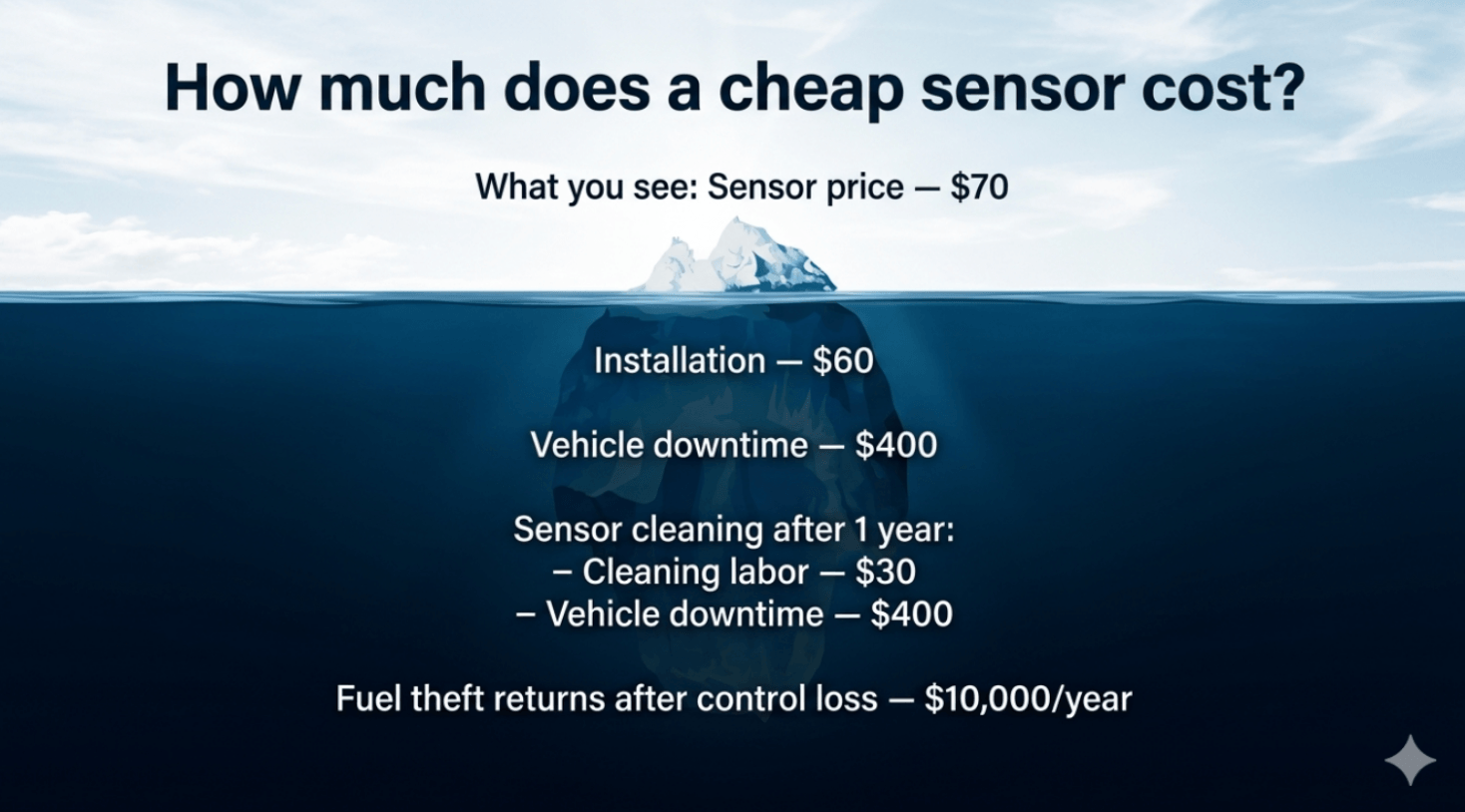
When a fleet manager picks a fuel-level sensor, the logic is simple: a sensor is a sensor. Going by what the manufacturer and the vendor promise, they’re all the same. One costs $80, another $200. So you buy the cheaper one. But there are also installation costs and running costs during operation. And those can be an unpleasant surprise.
Let’s break down what this really costs in practice. We’ll be talking about in-tank (fuel-immersion) level sensors. We’ll cover CAN data in a separate article. A CAN sensor is meant to inform the driver — whether they’ll make it to the next station or not — and it’s even less accurate for real fuel accounting than an in-tank sensor.
A cheap sensor requires a full tank calibration — the vehicle sits for about four hours while the fuel is drained and refilled in small increments. That’s another $300–400 in lost working time for every unit in the fleet. Installers often insist on draining the fuel from the vehicle, finding a station, or driving to one. In short, a mountain of hassle and wasted time. And installers frequently cut corners and fit cheap sensors without calibrating them at all — but then the refueling data will never add up.
Professional Omnicomm sensors with Calibratex technology calibrate automatically, and the entire installation takes just 40 minutes. Nothing depends on the installer or how diligent they are. The settings adjust themselves right after the first refueling. A vehicle can be fitted over a lunch break. You can read about Calibratex separately. Accuracy on the first refueling is absolute. Across several refuelings, matching the station receipts against the solution’s reports to within 1% is entirely achievable. In reality, the accuracy of the refueling itself plays a part too. Stations aren’t always honest. And here professional sensors help you identify stations that shortchange you.
Fuel isn’t always perfectly clean. Cheap sensors clog up. Their tubes have a small clearance, and grains of sand get stuck there easily, or paraffin drops out of solution. When a sensor clogs, the data lies. You’re blind again — and the drivers can feel it. You call out the installation crew. Cleaning plus recalibration is another $30 of labor and, once again, half a day of downtime, a $200 loss. And this can happen once a year — or, more likely, you’ll simply give up and stop bothering with it. Professional sensors clean themselves: a patented slotted-probe design gives dirt nowhere to lodge, so no servicing is needed. All the grime is washed away by the waves of fuel. The data stays consistently high-quality. Companies are starting to feed this data straight into their management reporting systems.
A vehicle moves along real roads and sits at angles. Fuel sloshes around inside the tank. All of this shows up in the sensor readings. Cheap sensors can’t properly filter the fuel movement caused by driving and tilting. That produces either false alarms or a blind spot for siphoning — anywhere from 5 to 7% of the tank’s volume.
Drivers will absolutely test the system on a dare. They’ll siphon off a jerrycan and see whether it gets noticed or not. On a 600-liter tank that’s 30–42 liters a driver can quietly drain, and the system “won’t see” two jerrycans siphoned off. Drivers figure this out fast. And that’s it — the system is broken. The investment in it is down the drain.
Professional Omnicomm LLS 6 AI sensors use AI-based wave filtering that adapts to the vehicle’s operating mode. They also correct the data for tank tilt. On that same tank this means a threshold of just 2% — around 12 liters on a 600-liter tank — too little for a single siphon, and too much hassle to drain bit by bit. Drivers get caught on the very first jerrycan, and the experiments stop right there. You’ll have transparent, accurate fuel data.
In many countries the stations sell biodiesel or ethanol blends. Cheap sensors can’t handle this: the error in detecting a biodiesel refueling reaches 40%. On ethanol they don’t work at all. The reports don’t match the station receipts — and trust in the system collapses. Even in countries with no biodiesel, error creeps in from differences in fuel composition. Every batch from the refinery is slightly different from the last. The crude source varies, and the additives used to hit the target specs vary too. All of this changes the fuel composition — and a cheap sensor is sensitive to it. The error reaches 5%. When the refuelings don’t add up, doubt sets in. And if you doubt whether you’re right, you can’t hold a conversation with the driver. The investment in the solution is down the drain.
Professional sensors with Fuelscan technology measure the fuel composition and hold 99.5% accuracy across any blend. The refueling numbers add up. Your case is beyond dispute.
This is a distinct and very important story. You want to catch a driver siphoning fuel — but you can only make the accusation when you’re sure of the data. With a cheap sensor, that certainty isn’t there. Drivers understand this quickly. And they start disputing every single report.
 Omnicomm has a huge accumulated customer base, and we know how both clients and drivers behave. After a cheap sensor is bought, we see two processes unfold — one on the management side, one on the driver side. Management watches with interest as fuel consumption drops following the rollout. The data doesn’t quite add up, but the result is impressive. Meanwhile the drivers are trying to hack the system — to work out where its sensitivity threshold lies. Within a few days of installation the first real trial siphons appear, and the system shows false siphons as well. Management confronts the drivers. The drivers quickly find the weak spots and prove the solution is inaccurate. Management loses its trump cards. Within 3–5 months the drivers understand what the solution can really do and go back to their usual siphoning. Over that same period management tries calling out the installers and tuning the cheap sensors, but you can’t fight physics. Management resigns itself to the fact that this is a toy. The solution gets handed off to the dispatchers, and management stops paying attention to it. The investment is down the drain, and the reputation is tarnished. The drivers snicker behind the boss’s back.
Do you really want people laughing behind your back?
The price of the sensor itself is the tip of the iceberg. The real cost lies in the downtime, the false data, and the schemes the system failed to stop. You recoup the investment in your vehicle over 3–4 years. The payback on a professional sensor falls within 3–6 months. That’s 12 times better! The urge to buy a cheaper sensor doesn’t speed the payback up to 2 months — it leads to major losses of investment and reputation.
Professional solutions from Omnicomm work for years, supplying the company with reliable, accurate data. Forward-thinking companies build that data into their management reporting systems.
Work with the professionals.
If you find our articles interesting, have a chat with our AI assistant on the website. She’ll sign you up for the newsletter and connect you with our flesh-and-blood team — salespeople and engineers — to answer all your questions.
India is bringing biodiesel into the diesel fleet. Entry-level

Omnicomm has long been associated in the market with